


The data is sobering. Across industries, somewhere between 60 and 90 percent of strategic plans fail to deliver their intended results. About nine in ten senior executives report missing strategic goals, not because their ideas were wrong, but because execution did not follow. In aviation, where capital is heavy, regulators are watchful, and safety is non-negotiable, a failed strategy is not an inconvenience. It is operational risk, regulatory exposure, and lost momentum. Now is the precise moment our industry can least afford to miscalculate on a strategy and fail to execute well.
In preparing for battle I have always found that plans are useless, but planning is indispensable.
Eisenhower understood something most boardrooms have not yet absorbed. The plan is not the point. The discipline of planning, with its choices, trade-offs, resourcing, and accountability, is the point. When that discipline collapses, the document on the shelf becomes worse than useless. It becomes a record of what we promised ourselves we would do and did not.
This piece is for aviation leaders at airlines, airports, ANSPs, OEMs, pilot associations, and regulators who are tired of strategic plans that look brilliant in PowerPoint and disappear within a quarter. We will look at the three failure modes that show up most often in the empirical and practitioner literature, the steps that separate implementable strategy from aspirational decoration, and the leadership behaviors that ultimately determine whether either ever takes hold.
The Strategy and Execution Gap
Strategic planning and strategy execution are different disciplines. Planning produces a document. Execution produces results. The two are connected by a fragile chain of decisions about budgets, people, technology, governance, and culture, and that chain breaks more often than it holds.
The cross-industry evidence is consistent. Multiple analyses converge on the same finding: most boards and C-suites significantly underestimate the organizational lift required to translate plans into action. They invest heavily in the formulation phase, in the offsite, the framework, the deck, and then assume the rest will follow. It rarely does.
In aviation, the consequences are amplified. A delayed safety management system upgrade, a fleet renewal that slips two years, an air traffic management modernization program that loses funding mid-cycle: these are not abstract performance gaps. They show up as risk on the safety register, as letters from the regulator, as customer attrition, and as a workforce that grows cynical about every successive plan. We cannot afford that cynicism. The industry is already navigating a difficult window of pilot demographics, sustainability mandates, infrastructure limits, and capital cycles. Plans that fail compound those pressures rather than relieving them.
Three Failure Modes Account for Most of the Damage
Reason One: Plans That Are Not Really Plans
The first failure mode is the strategy that is not actually a strategy. It is a wish list. The language is broad and inspirational. "Become a digital airline." "World-class safety culture." "Sustainable operations by the next decade." These phrases feel important and commit to nothing. They contain no choice, no trade-off, no sequencing, and no measure of whether the organization is closer or further from the destination at the end of any given quarter.
Strategy is choice. A real strategy says what the organization will do, what it will not do, and what it is willing to give up; making the chosen path possible. When leaders carry lists of "strategic priorities" with fifteen items, all equal in stated importance, they are not setting strategy. They are deferring it. Vague goals and a refusal to prioritize are core reasons that a plan will not convert into results.
The aviation manifestations are familiar. A safety strategy that aspires to "world-class culture" without naming the leading indicators that would tell us whether the culture is improving or deteriorating. A digital strategy that lists every emerging technology in the sector without specifying which two or three the organization will invest in. A sustainability strategy that points to a 2050 net-zero commitment without a fleet plan, an infrastructure plan, or an operational roadmap consistent with the regulatory timelines between now and then. Each of these documents passes board review. Each of them fails as soon as the first hard trade-off arrives.
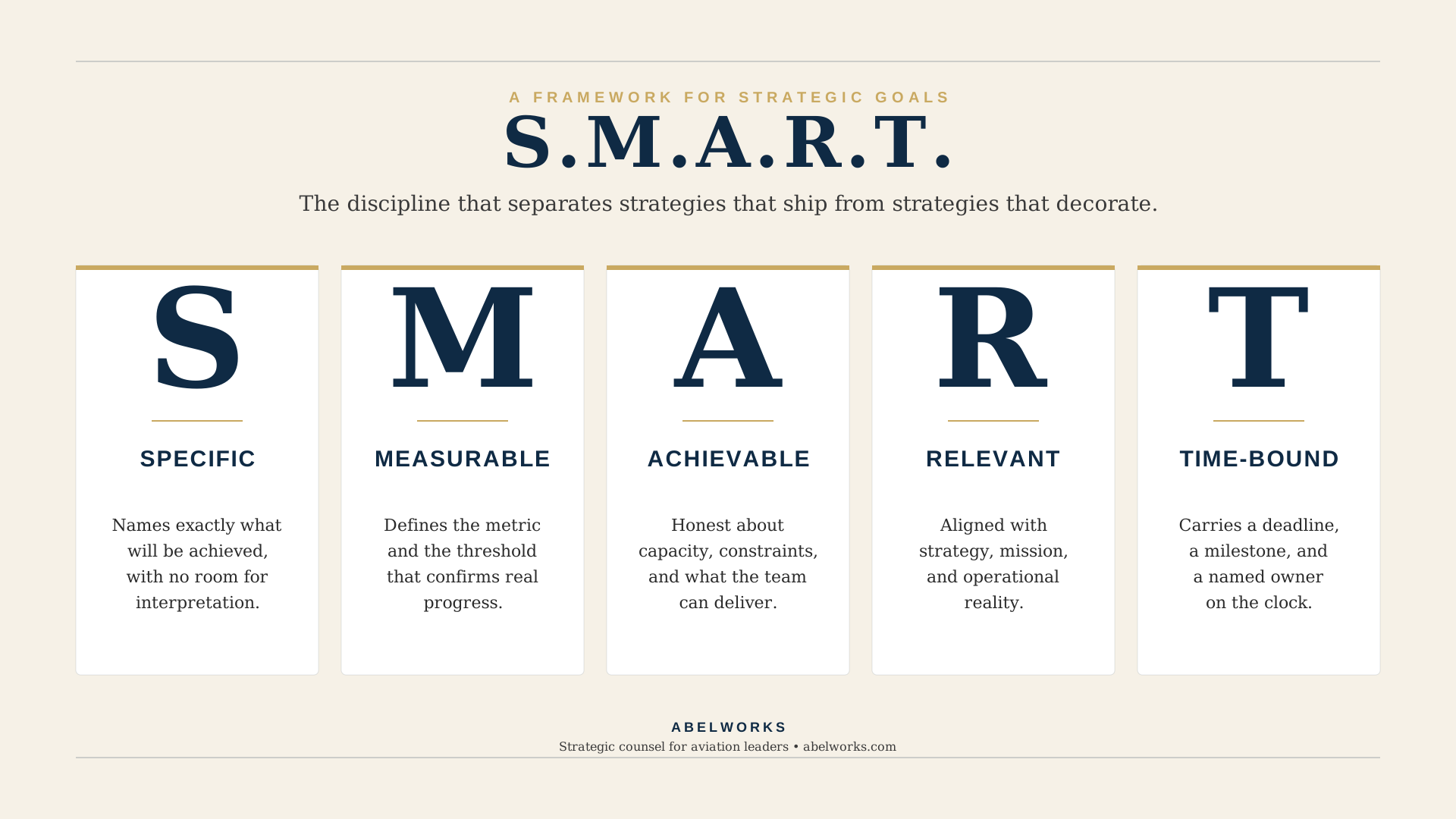
The corrective is unromantic. Strategic assessment must precede strategic ambition. We need a clear-eyed view of the current state, including operational performance, regulatory drivers, market position, fleet and network realities, workforce capabilities, and balance sheet capacity. From that ground, we translate broad aspirations into a small set of S.M.A.R.T. goals: specific, measurable, achievable, relevant, time-bound, and owned by named leaders. Three to five priorities. Not fifteen. We must also explicitly choose what we will not do in the next three to five years, because every priority that is not deselected steals oxygen from the ones that remain.
Reason Two: The Budget Tells the Truth
The second failure mode is resource starvation. The strategy document declares one set of priorities. The budget continues to fund another. Staffing models, capital allocations, and technology investments remain anchored to last year's commitments. The strategic initiatives are approved in principle and then expected to be delivered as stretch tasks by managers who are already fully booked on operations.
If you want to know what an organization's real strategy is, read the budget. The slide deck describes intent. The budget describes commitment. When the two disagree, the budget wins, every time.
This failure mode is particularly punishing in aviation, because the work that gets starved is rarely optional. Mandated safety enhancements. Cybersecurity hardening. Runway safety programs. SMS maturity work. ATC modernization. Workforce development programs that the next decade depends on. These initiatives carry regulatory clocks and safety stakes, and yet they are treated as discretionary because they sit outside the bow wave of daily operations. Engineering, maintenance, and operations leaders absorb the strategic load on top of the day job, and the predictable result is delay, partial delivery, and quiet attrition of the people who tried to carry it.
Closing this gap requires three commitments. First, strategy must drive the budget rather than the reverse. Capital and operating plans should be redrafted each cycle to reflect the strategic priorities, with explicit decisions about which legacy programs are shut down to free resources. Second, the implementation roadmap must be specific. Milestones, owners, budgets, dependencies, risks, and the governance forum where progress is reviewed must all be named in writing. Third, the cadence of review must be real. Quarterly strategy reviews, with the same discipline we apply to financial performance and safety performance, are not a luxury. They are the mechanism by which a plan stays alive between board meetings.
Treating strategic initiatives as side projects almost always produces the same result. They become the work that gets bumped when something urgent arrives, and in aviation, something urgent always arrives.
Reason Three: Strategy as Spectator Sport
The third failure mode is the plan that was developed by a small group at the top and handed down to an organization that had no part in shaping it. The deck is pristine. The cascade is broken.
The pattern is familiar. An executive team, sometimes with consultants, retreats to draft the strategy. Frontline expertise, middle management, safety leaders, and regulatory leads are involved late or not at all. The completed plan is communicated through town halls and intranet posts. Within a month, most employees can name the slogan but cannot tell you what their team is doing differently as a result. The strategy did not become operational because it was never connected to the people whose daily decisions would have made it so.
The research is consistent on this. Underestimating the need for engagement is among the most common reasons strategic plans fail. So is the absence of accountability, with no clear decision rights, no named owners for major initiatives, and no follow-through on the commitments leaders made when the plan was approved. In aviation, this shows up as a finished strategy deck arriving in the operations directorate without context, generating skepticism and passive resistance from the very people who would have to deliver it. It also shows up as regulatory and safety leaders learning about strategic directions late enough that compliance and certification timelines no longer align.
The corrective is to plan inclusively from the outset. Cross-functional leaders from operations, safety, engineering, IT, finance, and HR should participate in the formulation, not just the rollout. Communication plans must translate high-level strategy into plain language that connects to specific roles, so that an engineer, a controller, a customer service agent, and a maintenance technician can each answer the question of what the strategy means for what they do tomorrow. Decision rights must be made explicit. Strategic objectives must be tied to KPIs, performance reviews, and leadership scorecards, so that accountability becomes structural rather than aspirational.
People support what they help build. They tolerate what is handed to them, until they don't.
What Implementable Strategy Looks Like
These three failure modes, taken together, are well documented, and so is the antidote. The process steps are not exotic. They are simply applied with discipline, in sequence, and without skipping.
The first step is to build awareness and define the case for change. This means a shared, data-grounded view of the external environment, in market, regulatory, technological, and competitive terms, and an honest internal assessment of operational, safety, financial, and workforce performance. The data must be allowed to speak truth to power, even when the truth is uncomfortable. Strategies built on flattering inputs produce flattering outputs and disappointing results.
The second step is to formulate focused, S.M.A.R.T. goals. Three to five primary strategic goals, integrating safety, operational, financial, workforce, and digital dimensions, expressed in specific and measurable terms. The number matters. Beyond five, the organization cannot focus, and the priorities revert to a wish list.
The third step is rigorous current-state and gap analysis. We must assess where we stand today against each goal, and which capabilities, processes, technologies, or partnerships are missing. In aviation, this analysis must include regulatory readiness, safety risk assessments, and infrastructure constraints as explicit components, not afterthoughts.
The fourth step is to design a small number of high-impact initiatives for each goal, with clear outcomes, timelines, dependencies, and owners. Sequencing matters. Resource constraints, regulatory milestones, and operational capacity dictate that not everything can move at once. Strategies that try to do everything, everywhere, all at once succeed at none of it.
The fifth step is to build a real implementation roadmap. Budgets, people, technology, change management, training, communication, and stakeholder engagement should all be integrated into a single plan. For safety-critical changes, this roadmap also includes the engagement of regulators and unions early enough to keep timelines credible.
The sixth step is to establish monitoring, learning, and adaptation. KPIs and dashboards for progress. Regular review cadences that adapt the plan to new information, regulatory shifts, and market shocks. A culture that treats data-driven course correction as professionalism, not as failure.
None of this is glamorous. All of it is the work that separates strategies that ship from strategies that decorate.
The Leadership Variable
The hardest finding in the research, and the most useful one, is that leadership behavior matters more than the quality of the written plan. A mediocre plan with committed leadership outperforms a brilliant plan with ambivalent leadership.
Four leadership pitfalls show up repeatedly. The first is partial commitment, with public endorsement of the plan but no change in personal time allocation, decision behavior, or resource decisions. The second is over-ambition and denial, with goals and timelines that ignore organizational capacity and external constraints, set because they sounded good in the boardroom. The third is "plan on the shelf" syndrome, where once the document is approved, leaders revert to short-term operational pressures, and the plan quietly gathers dust. The fourth is insular decision-making, where senior leaders have lost touch with day-to-day operations and do not bring the right expertise into the room.
The corresponding leadership practices are not difficult to name. They are difficult to sustain. Model commitment from the top by rebalancing leadership time toward strategic topics in key forums, and by publicly connecting major decisions, in budget, fleet, hiring, and technology, to the strategic plan, so that the connection is visible to the organization. Right-size ambition by stress-testing strategic goals against honest capacity assessments and adjusting scope when the math does not work. Embed strategy into governance through regular implementation reviews at the executive level, with transparent performance data and clear escalation paths when trade-offs are required. Maintain operational fluency through structured engagement with frontline teams, including line checks, site visits, safety reporting reviews, and direct feedback channels.
For aviation leaders specifically, this includes tying strategic goals to safety leadership behaviors. How leaders respond to incidents. How they resource safety initiatives when the budget is tight. How they handle the trade-offs between throughput and safety when both are under pressure. These behaviors broadcast the real strategy more loudly than any document. We must also recognize that transparent communication with regulators, unions, and the workforce during strategy formulation and implementation is not optional. It is what maintains the trust that makes execution possible at all.
A Discipline, Not a Document
Strategic planning, done well, is not an annual ritual that produces a deck. It is a core management process that runs continuously, integrated with safety management, regulatory strategy, and operational excellence, and refreshed by data and dialogue rather than by calendar.
For aviation leaders willing to take this seriously, a few commitments anchor the work. Make grounded strategic choices, with a focused set of priorities. Link those priorities explicitly to budgets, staffing, and technology investments. Plan inclusively, with strong engagement from operations, safety, and frontline leadership. Build implementation roadmaps with named owners, KPIs, decision rights, and review cadences. Demonstrate, through visible leadership behavior, that the plan is real.
It is also worth periodically auditing past strategic plans, five years back and ten years back, and asking honestly which commitments were delivered, which were not, and why. That audit is uncomfortable, and it is one of the most valuable inputs to the next planning cycle.
Eisenhower's insight holds. Plans, as static documents, are useless. Planning, as a continuous discipline practiced by leaders who follow through, is indispensable. The strategies that fail in our industry are almost never failures of intelligence or imagination. They are failures of choice, resourcing, engagement, and follow-through. Each of those is recoverable, if leaders treat the plan as the beginning of the work rather than the end of it.
The window of opportunity for our industry to modernize, decarbonize, and renew is real, and it is not infinite. The aviation organizations that will navigate this decade well are the ones whose strategies ship. That is a leadership choice, made every day, long after the offsite ends.